Ghosts
Soul Guardian: A Hellishly Cozy FantasyGhosts are recurring supernatural inhabitants whose presence transforms the Sharoth household from an ordinary domestic space into a place where the dead participate in everyday life. They can produce moans and wails, manipulate objects, occupy the kitchen, and pass on specialized knowledge. Although humans cannot touch or harm them, demons can, making the ghosts simultaneously intangible by ordinary standards and physically vulnerable within the household’s supernatural order.
Presence in the Sharoth Household
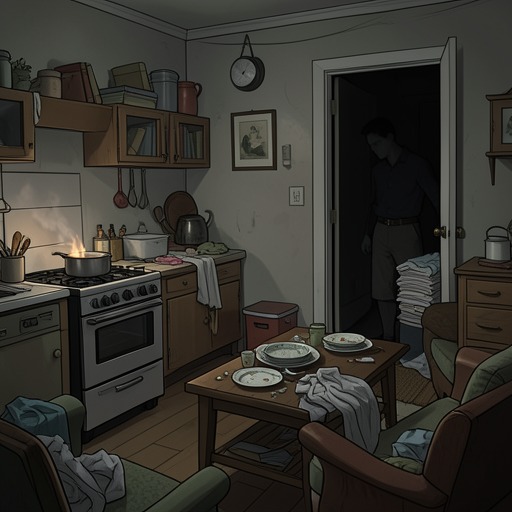
The ghosts first appear as a background chorus in Bael’s new recliner: their moans and wails lull him to sleep rather than frightening him awake. This reversal establishes the household’s distinctive supernatural normality. Haunting is not confined to a dramatic encounter or an abandoned ruin; it becomes part of the rhythm of domestic life, as familiar as furniture, breakfast, and the morning light. Their presence also helps define the house as a shared environment in which the living and the dead occupy the same routines.
The ghosts are not passive decorations. Their sounds affect Bael’s behavior, while their unseen activity alters the material arrangement of the kitchen. The ordinary world repeatedly becomes unreliable around them: food disappears, objects move, and a simple attempt at cooking turns into a confrontation with an invisible participant. The haunting therefore operates through interference with use. A kitchen object is no longer merely a tool, and breakfast is no longer controlled solely by the person preparing it.
The Kitchen Confrontation
Bael’s encounter with the ghost chef begins when the carton of eggs vanishes from the counter while he is trying to prepare breakfast. He treats the disappearance as deliberate sabotage and threatens to send the ghost away if the eggs are not returned. The carton promptly reappears, but the egg then skitters out of reach, proving that the disturbance is an active game rather than a single unexplained loss.
Bael answers invisible mischief with a material trap. He throws a salt shaker at the countertop, and the collision of salt and glass reveals a fat, confused ghost covered in salt like dust on a cobweb. The reveal shifts the scene from anticipation to grotesque physical comedy: the unseen presence becomes visible through the destruction of an everyday object. The kitchen’s tools become instruments of detection as well as attack.
The confrontation also demonstrates the limits of ghostly incorporeality. Bael swings a cast-iron frying pan at the revealed ghost. The hot oil passes harmlessly through the ethereal body, but the iron pan strikes with enough force to knock the ghost over. Bael can then seize the ghost by the collar, because demons possess abilities humans lack: humans cannot touch or harm ghosts, while demons can. The encounter makes the supernatural hierarchy concrete through an ordinary domestic object, turning a frying pan into proof that immateriality is conditional rather than absolute.
Bael’s anger is directed at the interruption of breakfast as much as at the ghost itself. He regards the ruined meal as an intolerable intrusion and demands to know why the ghost has been playing keep-away with his omelet. The scene’s comic violence reveals a practical relationship between the two kinds of beings: ghostly tricks can provoke demonic retaliation, but demonic force does not end the exchange. Instead, it compels the ghost to explain its purpose.
Victor and the Material Knowledge of Cooking
The ghost is Victor, a world-renowned chef whose expertise survives death. After being struck down, he explains that Bael is using a pan that is too hot, recommends beginning at a lower heat, advises butter instead of oil, and says that the eggs should reach room temperature. When Bael wakes him with a slap and demands a complete explanation suitable for a child, Victor reacts with horror at the indignity of having to teach basic egg cooking to someone who clearly does not understand it. His status as a celebrated chef contrasts sharply with his present condition: he is both an expert and a disembodied instructor forced to work within another person’s kitchen.
Victor’s instruction gives the ghost a function beyond haunting. He turns from an apparent nuisance into a teacher, and Bael’s threat becomes the beginning of an apprenticeship. The practical details remain central: Victor sets the oven to 250 degrees Fahrenheit, places two heavy stoneware plates inside, and uses the warmed oven as a place to bring the eggs, cheese, and ham to room temperature. The supernatural scene is consequently grounded in technique, temperature, ingredients, and equipment. Death has not erased Victor’s knowledge; it has changed the form through which that knowledge is exercised.
Victor’s helpfulness does not make him entirely reassuring. Bael watches him leave and senses something familiar and unsettling about him. That unease preserves a trace of the ghost’s original gothic function even after the relationship becomes cooperative. Victor is at once comic, useful, dead, and faintly ominous, a combination that keeps the household’s domestic comfort from becoming wholly ordinary.
From Haunting to Household Tradition
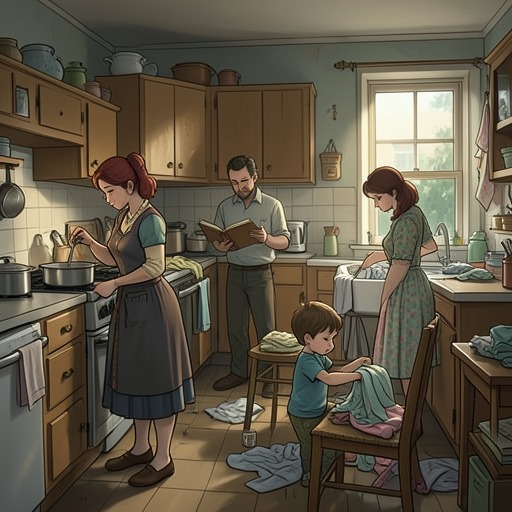
By the time breakfast becomes a regular tradition in the Sharoth household, the ghosts’ role has shifted from disruptive intrusion to participation in a recurring communal practice. Victor has become increasingly adept at cooking in ghostly form because he is no longer wasting energy on pointless window rattling. The change is significant: the ghostly capacity for disturbance is redirected into skilled labor, and haunting becomes contribution.
The household’s breakfast also shows how supernatural and material elements are woven together. Titan brings Bael a copy of the Forgotten Times and curls beneath the table waiting for falling bacon, while Victor prepares food that includes waffles, eggs, and bacon. The dead chef’s work is not presented as a spectacle separate from domestic life; it supports the same meal around which the household gathers. Ghostly activity becomes one of the mechanisms through which the household functions.
Victor’s development is accompanied by the disappearance of another supernatural presence from the house: Murphy is gone, leaving the house empty except for the ghost waiting in the kitchen for Bael to return with provisions. This arrangement emphasizes the ghost’s new position. Victor is no longer merely an unseen force occupying the margins of the home; he is a designated participant with expectations, supplies, and a student. His presence has acquired continuity and purpose.
Ghosts and Chosen Domesticity
The recurring breakfast scenes place ghosts within a broader pattern of found household relationships. Bael’s initial response is territorial and hostile: he believes the ghost is trying to drive him out and responds by threatening him over a carton of eggs. Yet the encounter ends not with banishment but with instruction, provisions, and repeated meals. The relationship changes because the ghost’s disruptive agency is recognized as knowledge that can be negotiated with.
This transformation makes the ghosts important to the novel’s treatment of domesticity. They complicate the boundary between life and death without dissolving it. Victor remains ethereal and can still rattle windows, but he can also cook; he can be knocked down by a cast-iron pan, yet he retains a professional identity; he can unsettle Bael, yet he helps make breakfast possible. The resulting household is not harmonious because the supernatural has been removed. It is functional because incompatible beings learn how to share space, redirect conflict, and turn haunting into a form of belonging.